Top Emergency Electricians in Riverhead, NY, 11792 | Compare & Call



Q&A
What's involved in getting a permit from the Town of Riverhead Building Department for a panel upgrade?
As a Master Electrician, I handle the red tape. The process starts with a detailed application and electrical diagrams submitted to the Town of Riverhead Building Department. All work must comply with NEC 2020 and will be inspected at rough-in and final completion. I also ensure full compliance with the Suffolk County Department of Labor, Licensing and Consumer Affairs for licensing and insurance requirements. You receive the final approval certificate for your records, confirming the upgrade is both safe and legally recognized.
I'm in Downtown Riverhead and my power is out with a burning smell from an outlet. How fast can an electrician get here?
For an emergency like a burning smell, which indicates a potential fire hazard, we prioritize immediate dispatch. From our starting point near the Riverhead County Center, we use the Long Island Expressway (I-495) for the fastest route, aiming for a 10-15 minute response to Downtown Riverhead. Our first action on site is to safely de-energize the affected circuit and locate the source of the overheating to prevent further damage.
My smart devices keep resetting and lights flicker during storms. Is this a PSEG Long Island grid problem or my house?
Coastal seasonal storms on Long Island create moderate surge risks that can affect the PSEG grid, but flickering inside your home often points to internal wiring issues like loose connections at the service entrance or within the panel. These micro-surges are particularly damaging to sensitive smart home electronics. Installing a whole-house surge protector at the main panel, combined with point-of-use protectors, creates a defense-in-depth strategy to shield your investment from both external and internal power quality problems.
My power comes from an overhead mast on the side of my house. What are the common issues with this setup in a suburban area like mine?
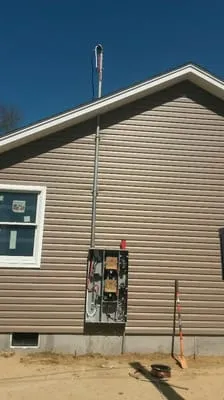
Overhead service masts are common in suburban Riverhead but have specific vulnerabilities. The mast itself can be damaged by weather or falling tree limbs, and the connection point at the roof penetration is a frequent leak source. Inside, the service conductors land on the main panel's bus bars; corrosion or loose lugs here cause flickering and heat. During an inspection, we check the mast's structural integrity, the weatherhead seal, and the torque on all service connections to ensure a safe, reliable point of entry for your home's power.
My Downtown Riverhead home was built in 1990 and has original NM-B Romex wiring. Why do my lights dim when the microwave runs?
Your electrical system is 36 years old and was designed for a different era. NM-B Romex from that time, while safe for its original load, isn't optimized for the simultaneous demands of modern 2026 appliances like induction cooktops and multiple large-screen TVs. The 150A service panel might be maxed out, causing voltage drop under load. An upgrade to a 200A panel with dedicated circuits often resolves this by providing the stable power today's homes require.
I want to install a Level 2 EV charger and a heat pump. Can my 1990s home with a 150A panel and a Federal Pacific panel handle it?
Two major issues need addressing before installation. First, Federal Pacific panels are a known fire hazard and are not listed for safe operation; replacement is non-negotiable. Second, a 150A panel from 1990 likely lacks the spare capacity for a 40-50A EV charger and a 30-50A heat pump circuit. A full load calculation is required, but upgrading to a modern 200A panel with AFCI and GFCI protection is the standard, safe solution for supporting these high-demand modern systems.
How should I prepare my Riverhead home's electrical system for winter ice storms and summer AC brownouts?
Preparation involves backup power and surge protection. For winter lows near 15°F, a hardwired standby generator with an automatic transfer switch ensures heat and sump pumps run during prolonged outages. Summer AC peaks strain the grid, making whole-house surge protection critical to guard against brownout-related voltage fluctuations. Scheduling a pre-season electrical health check can identify weak points, like aging breakers or undersized wiring, before extreme weather tests them.
We have very flat, sandy soil near the Riverhead County Center. Could that affect my home's electrical grounding?
Yes, terrain directly impacts grounding efficacy. The flat coastal plain and sandy soil common in the area can have high soil resistivity, meaning your grounding electrode system may not disperse fault current as effectively as code intends. This can compromise safety during a lightning strike or internal fault. We often recommend testing ground resistance and potentially installing additional ground rods or a concrete-encased electrode (Ufer ground) to achieve a low-resistance path to earth, as required by NEC 2020.
