Top Emergency Electricians in Benson, NC, 27504 | Compare & Call


Frequently Asked Questions
Our 1981 Downtown Benson home's lights dim when the microwave runs. Is the original wiring failing?
It's likely a capacity issue. Your home's original NM-B Romex wiring is now 45 years old and was designed for a different era of appliance use. Modern kitchen gadgets, home offices, and HVAC systems draw far more power than 1981 standards anticipated. This can cause voltage drop on shared circuits, manifesting as dimming lights. An assessment can identify overloaded circuits and determine if a service upgrade or dedicated branch circuits are needed.
Our smart TVs and routers keep getting fried during Benson thunderstorms. What's wrong?
Duke Energy Progress serves a region with high lightning strike frequency, leading to grid surges that can overwhelm basic power strips. Modern electronics with sensitive microchips are particularly vulnerable. A whole-house surge protective device (SPD) installed at your main service panel is the professional solution. It diverts massive surge energy to ground before it enters your home's wiring, providing a first line of defense that outlet strips alone cannot match.
We have an old 150A Federal Pacific panel. Can we add an EV charger or heat pump?
A Federal Pacific panel must be replaced before adding any major load. These panels are a known fire hazard due to breakers that can fail to trip. Even if the 150A service capacity is theoretically sufficient for a moderate Level 2 charger, the unsafe panel cannot be used. The upgrade involves replacing the panel with a modern, UL-listed unit and ensuring your home's grounding and service conductors can handle the new, continuous load of an EV charger or heat pump.
Do I need a permit from the Town of Benson to replace my electrical panel?
Absolutely. The Town of Benson Planning & Development Department requires a permit for a panel replacement, and the work must be inspected. As a Master Electrician licensed by the North Carolina State Board of Examiners, I handle the permit process and ensure the installation meets the current NEC 2023 code. This compliance is not just red tape; it's your guarantee the work is done safely, to standard, and is properly documented for future home sales or insurance reviews.
We have overhead lines coming to our house. Does that make our power less reliable?
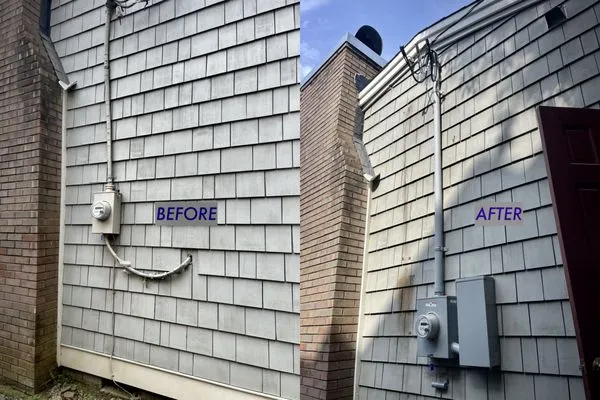
Overhead service, common in Downtown Benson, is more exposed to weather, trees, and vehicle accidents than underground lines. The mast where the service drop attaches to your house must be structurally sound. While Duke Energy maintains the lines to the weatherhead, the mast and service entrance cables are homeowner responsibility. We inspect these components for corrosion, proper sealing, and secure attachment to prevent water intrusion or a physical pull-out, which are frequent failure points.
How do I prepare my Benson home's electrical system for summer brownouts or an ice storm?
For summer AC peaks, ensure your HVAC system is on a dedicated, properly sized circuit to prevent overloads. For winter storm preparedness, consider a professionally installed generator with a transfer switch to safely back up essential circuits. In both scenarios, a whole-house surge protector is a wise investment to guard against the voltage spikes that often occur when Duke Energy's grid restores power after an outage.
I smell burning from an outlet in Benson. Who can get here fastest?
Treat any burning smell as an urgent fire risk and shut off power to that circuit at your panel immediately. From our dispatch point near the Benson Municipal Building, we're positioned to use I-95 for rapid access, typically arriving within 3-5 minutes to most Downtown Benson locations. This quick response is critical to locate the overheating connection, which is often a loose terminal, before it causes an arc fault or fire.
Does the flat, sandy soil around Downtown Benson affect our home's electrical grounding?
Yes, terrain influences grounding effectiveness. The flat coastal plain soil here can be sandy or have a high water table, which impacts the conductivity of your grounding electrode system. Proper grounding is non-negotiable for safety and surge protection. We perform ground resistance tests to ensure your grounding rods or UFER (concrete-encased) electrode, if present, meet NEC requirements and provide a low-impedance path to earth, especially important with our area's lightning risk.
