Top Emergency Electricians in McDonough, GA, 30252 | Compare & Call


Mr. Electric of McDonough
Q&A
We have huge old trees near the house. Could that be affecting our electricity?
Yes, the heavy tree canopy common around McDonough Square and Cotton Fields can impact electrical health. Branches rubbing against overhead service lines can damage insulation and cause intermittent faults. Tree roots may also disrupt underground grounding electrode conductors, compromising your home's critical safety path to earth. We recommend periodic visual checks of the line from the mast to the utility pole and having an electrician test your grounding system.
I found a Federal Pacific panel in my house. How urgent is it to replace, and can I add an EV charger?
Replacing a Federal Pacific panel is a critical safety priority. These panels are known for faulty breakers that fail to trip during overloads, creating a serious fire hazard. Your existing 200-amp service has the capacity for a Level 2 EV charger or heat pump, but the work cannot be performed safely on the recalled panel. We must upgrade to a modern, UL-listed panel with AFCI breakers before adding any major new load.
I want to add a circuit. Does it need a permit from Henry County, and what code do you follow?
Yes, most electrical work beyond a like-for-like replacement requires a permit from the Henry County Building Department. As a Master Electrician licensed by the Georgia State Board of Electrical Contractors, I pull all necessary permits and schedule inspections. We perform all work to the NEC 2020 code, which is the adopted standard in Georgia. This ensures the installation is documented, safe, and adds value to your property.
The power is completely out but my neighbors have lights. Who do I call for an emergency in McDonough?
First, check your main panel for tripped breakers. If the panel is dead, call Georgia Power to report an outage on your service line. For any burning smell, sparking, or if the outage is isolated to part of your home, you need a licensed electrician immediately. From McDonough Square, we can typically dispatch to the Cotton Fields neighborhood via I-75 in under 12 minutes for emergencies that threaten safety or property.
My McDonough home was built around 2005 and the lights dim when the AC kicks on. Is my wiring outdated?
A 21-year-old electrical system, common in the Cotton Fields area, was designed for a different era of power consumption. Original NM-B Romex wiring is generally sound, but the number and amperage of circuits often can't keep up with today's high-draw appliances, smart home hubs, and device chargers. This mismatch causes voltage drops, seen as dimming lights. We assess your 200-amp panel's load calculation and circuit layout to ensure your home's capacity matches modern life.
Why do my lights flicker and my modem reset during storms here in Henry County?
Flickering often points to a loose connection, either at your panel, an outlet, or on Georgia Power's overhead lines. Our region's high lightning activity also causes rapid grid voltage fluctuations and powerful surges that basic power strips can't stop. These surges degrade sensitive electronics over time. Installing a whole-house surge protector at your service entrance is a standard recommendation to defend your appliances and smart home systems.
My power comes from an overhead line on a mast. What maintenance does that require?
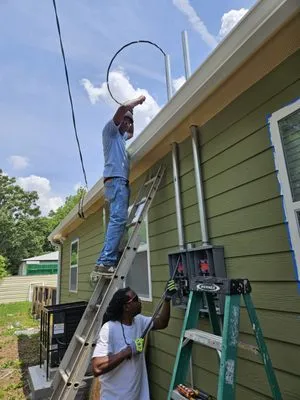
Overhead service masts require inspection for weather-tight integrity where the conduit enters your roof. The mast itself must remain plumb and secure; high winds or fallen limbs can damage it. The utility owns the line to the weatherhead, but you are responsible for the mast, conduit, and meter base. We check for corrosion, proper sealing, and structural soundness during a routine service evaluation to prevent water intrusion and physical failure.
How can I prepare my home's electrical system for Georgia summer brownouts or winter ice storms?
For summer peak loads, ensure your HVAC system is on a dedicated, properly sized circuit and consider a hardwired surge protector. For winter storm preparedness, a permanently installed generator with an automatic transfer switch is the safest, most reliable backup. Avoid connecting portable generators directly to your home's wiring without a proper transfer switch; backfeeding the grid is illegal and extremely dangerous to utility workers.
